
Everyone is talking about AI engineers. Almost nobody is talking about the people who have to make AI safe to run in production. That gap is quietly turning into one of the biggest career opportunities in tech: the AI Security Architect.
I recently watched a talk by Mike Gibbs of Go Cloud Architects that makes a compelling case for why this role is exploding — and why so few people are qualified for it. Here’s my take on the argument, plus what it means if you’re thinking about your next career move.
Two shortages colliding
The tech industry has been dealing with two separate talent shortages for years:
There aren’t enough security architects — not people who can operate security tools, but people who can design a comprehensive security programme spanning identity, network, cloud, application security, data protection, governance, compliance, and incident response.
And there aren’t enough AI architects — plenty of engineers can call an API or ship a demo, but very few can design an enterprise AI system that actually produces business value.
The AI Security Architect sits exactly where these two shortages collide. High demand, almost no supply. If you believe in supply and demand curves, you know what that does to compensation.
Why now? Because AI moved from experiments to production
The dynamic driving all of this: organisations are adopting AI faster than their security, governance, and compliance teams can keep up. The board wants AI, the CEO wants AI, every business unit wants AI — and most of them are deploying it without anyone who can answer the hard questions.
The numbers Gibbs cites paint a rough picture:
- A World Economic Forum report found 63% of employers see skill gaps as the main barrier to transformation.
- In the ISC² 2025 Cybersecurity Workforce Study, 73% of security professionals said AI will create demand for more specialised cybersecurity skills, and 72% said it will demand more strategic security mindsets.
- An IBM survey (reported by ITPro) found only 11% of technology executives feel prepared to deploy AI agents at scale — and 77% admit AI adoption is outpacing their governance capabilities.
- Per CIO magazine, 70% of CIOs discovered AI running on their systems that nobody had told them about. Shadow AI is real.
That last point is worth sitting with. When AI moves into production, it stops being a technical curiosity and becomes a business dependency. AI systems now touch customer data, regulated workflows, and automated decisions — and AI agents can act, not just recommend. That’s not just technical risk any more. It’s legal risk, brand risk, operational risk, and financial risk.
Engineer vs. architect: a different kind of question
The core distinction in the talk is simple: AI engineers build systems. AI security architects decide how those systems can be used safely.
Take a bank that wants to use generative AI to summarise customer portfolios. The engineer asks: which model, which API, what interface? All valid questions. The architect asks a completely different set:
- What customer data will the system access, and who approves that access?
- Is the data regulated? Can the model retain previous prompts? Can it leak sensitive information?
- How do we authenticate users, authorise access, and log what actually happened?
- How do we validate outputs and prevent hallucinations from turning into bad financial advice?
- Should we even build this — and if so, this way or another way?
“Can we build it?” is engineering. “Should we build it, and what could go wrong?” is architecture. Architecture is a decision quality job, not a tool knowledge job.
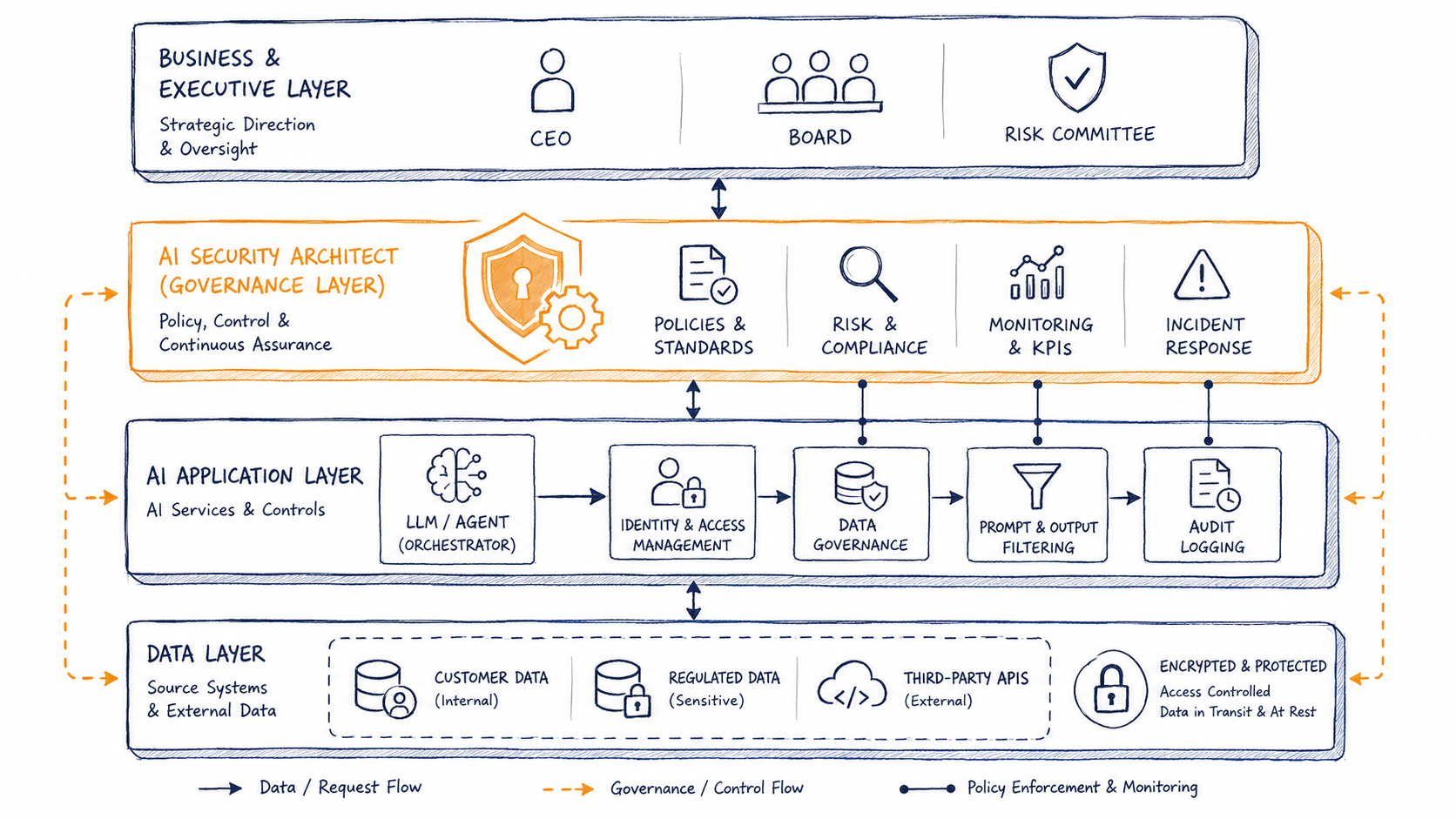
In practice, that looks like a governance layer sitting between the board and the systems that actually touch customer data — policies, risk controls, monitoring, and incident response flowing down into identity, data governance, filtering, and audit logging.
The five skills that actually matter
According to Gibbs, the role rests on five capability areas:
- AI architecture — use cases, data models, model selection, AI agents, model lifecycle, evaluation and monitoring. As a strategist and decision maker, not as a coder.
- Security architecture — threat modelling, data protection, cloud and application security, zero trust, governance, incident response, risk management. At the design level, not the tool-operator level.
- Business acumen — revenue vs. cost vs. risk, business operations, customer experience, compliance exposure, executive priorities. This is where most candidates fail.
- Executive communication — explaining complex AI security risks in plain language. No jargon, no tool dumping. Executives need the decision, the risk, the trade-offs, and the business impact.
- Leadership and governance — aligning security, cloud, data, legal, compliance, and finance teams plus executives and vendors. AI without governance is just risk at computer speed.
The communication point deserves its own example, because it’s brilliant. A CEO does not want to hear:
“We need to implement better model isolation, prompt filtering, and token-level monitoring.”
That architecture never gets funded. What the CEO needs to hear:
“If we deploy this AI system without proper governance, confidential customer data could be exposed, regulators could get involved, and our reputation could be harmed. Here’s a safer approach that still lets us move quickly.”
Same substance, completely different outcome. Translate prompt injection into business process compromise. Translate data leakage into regulatory and reputational risk. Translate shadow AI into uncontrolled enterprise exposure. That’s how architects speak.
Why certifications alone won’t get you there
Certifications help — they teach terminology, they get your CV past filters, they show initiative. But they don’t prove you can sit with a CIO, advise a CISO, or explain AI risk to a board. That’s why so many certified people still don’t get hired as architects: in the interview, they answer like engineers, describing tools and configurations, when the hiring manager is testing for judgement, trade-off thinking, and executive trust.
How to position yourself
If this role appeals to you, the positioning advice boils down to four moves:
Stop selling tools. “I know AWS and Python” is engineering positioning. Instead: “I help organisations design AI systems that create business value while reducing security, compliance, and operational risk.”
Train architecture thinking. Whenever you study AI or security, ask: what business outcome are we after? What data is required? What risks does this introduce? What governance and controls are needed? What trade-offs exist? What metrics prove success?
Build a portfolio of decisions, not demos. Business-first case studies: a secure AI customer service architecture, a secure AI agent reference architecture, a healthcare-compliant AI design, a financial services AI risk architecture. For each one, document the business goals, stakeholders, risks, controls, trade-offs, and executive recommendations.
Practise executive translation. Take every technical topic you know and rehearse explaining it in business language until it’s second nature.
My takeaway
Working in cloud consulting, I see this gap constantly: companies that shipped their first AI features months ago and are only now asking who owns the risk. The engineering talent exists. The governance and security architecture talent largely doesn’t.
The role is hot precisely because it’s hard — it demands depth in two domains (AI and security) plus the business and communication skills that most technical career paths never teach. That combination is rare, and rare plus critical equals valuable.
Engineers build. Architects decide. In the age of AI agents acting autonomously on production systems, the people who can secure those decisions are going to be some of the most valuable professionals in tech.