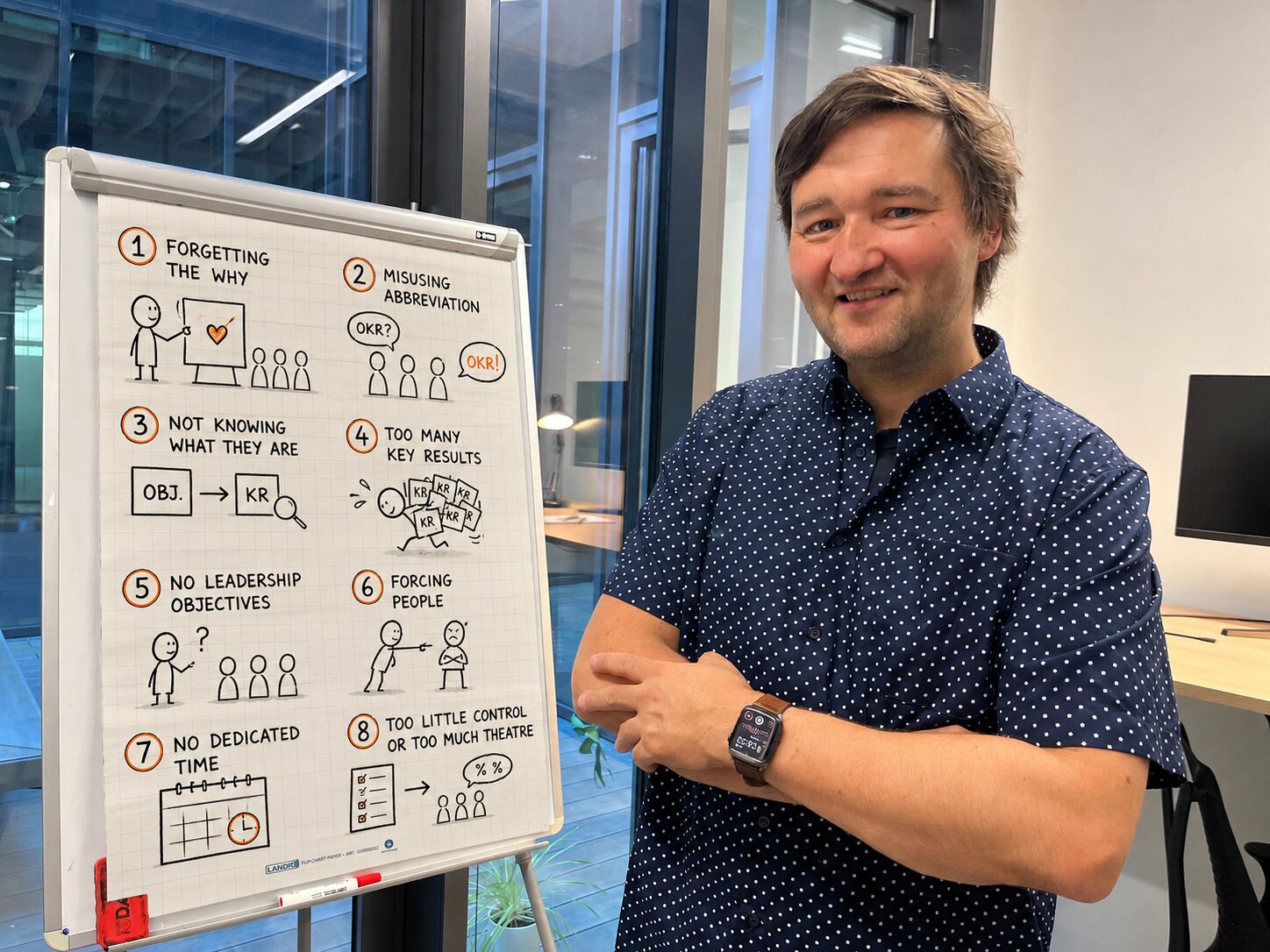
I’m not an OKR expert. I won’t pretend otherwise. What I have done is watch several companies try to introduce Objectives and Key Results — and trip over the same stones. Different industries, different sizes, same eight mistakes. If you’re about to roll OKRs out (or dust them off after a quiet failure), you don’t need to make them. A second attempt costs money, trust, and attention you won’t get back easily.
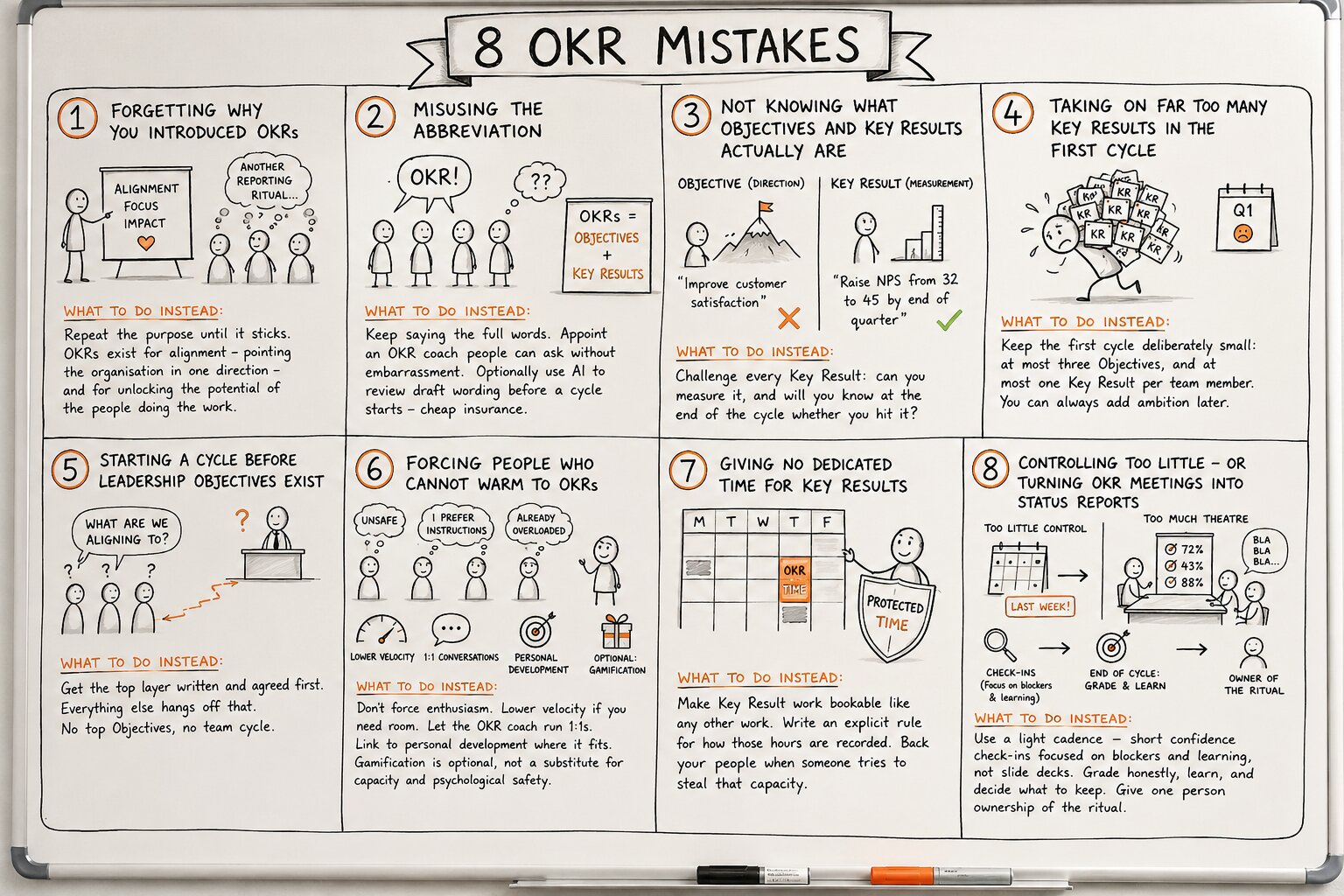
1. Forgetting why you introduced OKRs
Alignment sounds good in the kick-off slide. Three months later, people treat the framework as another reporting ritual. Without a clear “why”, OKRs become theatre with nicer vocabulary.
What to do instead: Repeat the purpose until it sticks. OKRs exist for alignment — pointing the organisation in one direction — and for unlocking the potential of the people doing the work. Say that often. In leadership meetings. In team kick-offs. When someone asks “why are we doing this again?”
2. Misusing the abbreviation
“OKR” gets thrown around as if everyone shares a definition. They don’t. The letters stand for Objectives and Key Results. When the abbreviation becomes jargon, the method loses its meaning.
What to do instead: Keep saying the full words. Appoint an OKR coach people can ask without embarrassment. Optionally use AI to review draft wording before a cycle starts — cheap insurance against fuzzy language.
3. Not knowing what Objectives and Key Results actually are
This follows from (2). Objectives are the direction you want. Key Results are how you know you’re moving. When those blur, Key Results stop being measurable. “Improve customer satisfaction” is an Objective dressed up as a Key Result. “Raise NPS from 32 to 45 by end of quarter” is a Key Result.
What to do instead: The same coach (and careful AI review) should challenge every Key Result: can you measure it, and will you know at the end of the cycle whether you hit it?
4. Taking on far too many Key Results in the first cycle
Ambition feels productive. Mid-cycle, it feels like debt — and the framework, not the planning, takes the blame.
What to do instead: Keep the first cycle deliberately small: at most three Objectives, and at most one Key Result per team member. You can always add ambition later. You cannot easily recover from a cycle that “proved” the method doesn’t work because everyone was overloaded.
5. Starting a cycle before leadership Objectives exist
I’ve seen iterations start whilst the managing directors’ Objectives were still undecided. That is a no-go. You cannot align teams to a direction that does not exist yet.
What to do instead: Get the top layer written and agreed first. Everything else hangs off that. No top Objectives, no team cycle.
6. Forcing people who cannot warm to OKRs
Some people feel unsafe when asked to own outcomes rather than tasks. Others prefer clear top-down instruction. Many are already overloaded and read OKRs as unpaid overtime with better branding. That is not sabotage; it is human.
What to do instead: Don’t force enthusiasm. Lower the team’s delivery velocity if you need room. Let the OKR coach run individual conversations. Link the cycle to personal development talks where that fits — personal goals and company Objectives don’t have to live in separate universes. Light gamification can help some teams; it is optional, not a substitute for capacity and psychological safety.
7. Giving no dedicated time for Key Results
If OKR work has to happen “on top” of everything else, it will not happen. Leadership must protect that time — managing directors included. Without cover from above, OKRs die quietly when the calendar fills with “urgent” firefighting.
What to do instead: Make Key Result work bookable like any other work. Write an explicit rule for how those hours are recorded. Back your people when someone tries to steal that capacity.
8. Controlling too little — or turning OKR meetings into status reports
Either Objectives and Key Results get forgotten until the last week of the cycle, or every OKR meeting becomes a status report where people defend percentages instead of solving problems. Too little steering and too much theatre produce the same outcome: nobody learns, and leadership loses confidence in the method.
What to do instead: Use a light cadence — short confidence check-ins focused on blockers and learning, not slide decks. At the end of the cycle, grade honestly, learn, and decide what to keep. Give one person ownership of the ritual so it doesn’t evaporate when calendars get busy.
Which of these eight already feels familiar in your organisation — and what will you change before the first cycle starts?